
Off-Grid Land for Sale in Oklahoma
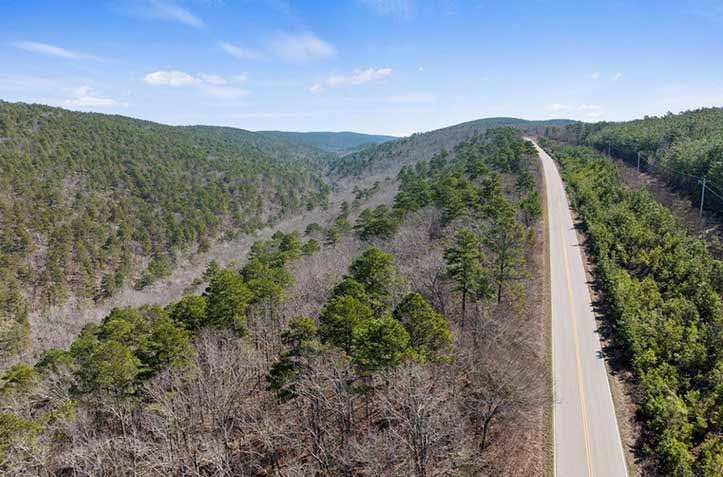
Off-grid living is legal in Oklahoma, and this corner of the state is one of the cheapest places in the country to do it with 50-odd inches of rain and standing timber. What it is not is unregulated. You can harvest rainwater, drill a domestic well without a state permit, generate your own power and never speak to a utility — but the state still decides how your sewage is handled, and that single rule shapes most off-grid builds in the Kiamichi Mountains.
This page is the practical version: what is actually regulated, what each piece costs, which tracts are for sale today, and the guide that answers each question in full.
One thing separates this land from most acreage marketed as off-grid. Here it is a choice rather than a consequence. Every tract is surveyed, carries deeded legal access, and has a graded gravel road to the property line, and utility service is arranged before you close — that is what guaranteed utilities means on this site. Cheap off-grid acreage usually gets its price from the thing it is missing: no recorded easement, no road, no water. Go off-grid because you want to, not because the tract left you no choice.
Off-grid tracts for sale today
| Lot | Size | Price | Development |
|---|---|---|---|
| Lot 30 | 5.51 acres | $19,500 | The Preserve at Boktuklo Mountain |
1 lot is available today. Select a parcel on the tracking map to see where it sits, or get in touch to walk it.
What Oklahoma actually regulates, and what it leaves alone
Sewage is the hard stop
The Department of Environmental Quality regulates human waste disposal everywhere in Oklahoma, however remote the tract. A soil evaluation decides which system you are allowed to install, and an Authorization to Construct comes before the system goes in. This is the one rule that has no rural exemption and no way around it.
A domestic well needs no state permit
Oklahoma does not require a state permit for a household well, and rainwater harvesting is legal. Where a rural water district line runs past the tract you can take a tap instead. Either way, price the water before you make an offer — it is usually the second-largest number after the land.
Power is optional here
Southeastern Oklahoma is served by member-owned electric cooperatives, not an investor-owned utility. Nobody obliges you to take service. If you want it, the co-op applies a construction allowance and bills the balance of extending line to you, so the quote depends entirely on the distance to the nearest pole — call with the legal description and ask for a staking estimate. If you do not, solar and a generator are entirely legal.
RVs and tiny homes are a local question
Oklahoma has no statewide law on living full-time in an RV or a tiny home on land you own. It is decided locally, and the unincorporated parts of LeFlore, Latimer and Pushmataha counties have no county zoning ordinance to decide it. Septic is still the binding constraint, and covenants inside a development may say more than the county does.
Can you live in an RV or tiny home on your own land? · Building permits and zoning in LeFlore County
What it costs to take five acres off the grid
Four line items decide whether an off-grid build works. Every figure below is sourced on the guide it links to; nothing here is estimated.
| What | Typical cost | The detail |
|---|---|---|
| DEQ soil evaluation | $350 to $550 | Perc tests and septic systems |
| Septic system | $7,500 conventional to $15,000 aerobic | Kiamichi soils rule out conventional lateral fields more often than buyers expect |
| Water well | $30 to $50 per foot, typically 100 to 400 feet | What it really costs to develop raw land |
| Electric line extension | Co-op allowance, then the balance per foot | Free staking estimate — ask before you make an offer, or skip power entirely |
| Property tax | A few hundred dollars a year | Property taxes on raw land |
Water and sewage together run roughly $11,000 to $35,000 on five acres, depending on how deep you drill and which septic system the soil allows. Power is the variable one: it is either a co-op quote that depends entirely on how far the nearest pole is, or it is solar and no bill at all. For land prices region by region and the whole budget in one place, see how much 5 acres costs in Oklahoma.
Where the off-grid ground is
The Boktuklo range
Our remaining tracts sit in the Boktuklo range of the Kiamichi Mountains, in a 1,229-acre development surrounded by undeveloped land and bordering the Three Rivers Wildlife Management Area to the south. Elevation, timber, and no neighbors you can see.
LeFlore County
The Ouachita end of the region: Talimena Drive, the Ouachita National Forest, and the county where the permit and zoning questions are best documented on this site. Poteau and Talihina are the towns most buyers stage out of.
Latimer County
The cheapest ground in the region by county average, and the quietest. Wilburton, Red Oak and the Kiamichi front range, with Robbers Cave State Park to the north.
Frequently asked questions about off-grid land in Oklahoma
Yes. You can harvest rainwater, drill a domestic well without a state permit, generate your own power and disconnect from the utility entirely. The exception is sewage: the Oklahoma Department of Environmental Quality regulates waste disposal statewide, regardless of how remote the property is, and that requirement has no rural exemption. Our full breakdown, with the statutes, is at is off-grid living legal in Oklahoma.
In the unincorporated parts of LeFlore, Latimer and Pushmataha counties there is no county zoning ordinance, so there is usually no county building permit to pull. That is not the same as no rules: DEQ still authorizes the septic system, the state adopts building codes that apply to certain work, and a development's own covenants may set standards the county does not. See building permits and zoning on rural land in LeFlore County.
Oklahoma has no statewide law that permits or forbids it, so it is decided locally — and in unincorporated southeastern Oklahoma there is often no local rule either. The constraint that actually binds is sewage disposal. The full answer, including manufactured housing, is at can you live in an RV or tiny home on your own land in Oklahoma.
Roughly $30 to $50 per foot, at typical depths of 100 to 400 feet. Depth varies with the geology under a specific tract, which is why the range is wide. Where a rural water district line runs past the property, a tap replaces the well entirely. Figures and co-op contacts are in what it really costs to develop raw land.
A DEQ soil evaluation runs $350 to $550 and decides the answer. A conventional gravity lateral field runs around $7,500; an aerobic system runs closer to $15,000. In the Kiamichis, shallow bedrock and slow clay rule out conventional fields more often than buyers expect, so test before closing rather than after. See perc tests and septic systems on Oklahoma land.
They are off-grid capable, which is not the same thing. Every tract is surveyed, has deeded legal access and a graded gravel road to the property line, and utility service is coordinated before closing. You can run the place on solar and a well and never connect, or you can take service — the choice is yours rather than the land's. Current availability and pricing is on the available land page.
County average asking prices in the southeastern mountain counties run about $3,461 to $5,870 an acre, and small tracts carry a premium over that. Add roughly $11,000 to $35,000 for water and septic on five acres, plus whatever the co-op quotes for power if you want it. The full regional breakdown is at how much does 5 acres cost in Oklahoma.
See what is available
Every remaining tract is drawn on the tracking map with its acreage and price, and listed on the available land page. Owner financing is available, and Seth will walk any of it with you — get in touch.